4.9-Star Rated
41 Google Reviews
← All Articles
September 2026·6 min read

How Much Attic Insulation Do You Need in Arizona, by Home Age?

The answer depends on when your home was built. Most Arizona homes need R-38 to R-49 of attic insulation, but homes built before 1990 often have R-11 or less sitting up there. Here's how to read your attic by decade.

Attic insulation R-value: R-value measures an insulation material's resistance to heat flow. The higher the R-value, the more effective the insulation is at slowing heat transfer. The U.S. Department of Energy recommends R-38 to R-60 for attics in hot climates like southern Arizona, which falls in DOE Climate Zone 2.

How much attic insulation does an Arizona home actually need?

Most Arizona homes need between R-38 and R-49 of attic insulation, and the U.S. Department of Energy recommends R-38 to R-60 for hot climates like southern Arizona. That range accounts for DOE Climate Zone 2, which covers Tucson, Marana, Oro Valley, Vail, Sahuarita, and the surrounding communities we work in every week.

R-value is just a measure of thermal resistance. The higher the number, the harder it is for heat to move through the insulation. In an attic that can hit 150°F on a July afternoon, that resistance is the only thing standing between your living space and a furnace. When we talk about R-38 to R-49 as our target range, we're talking about roughly 12 to 16 inches of blown-in fiberglass sitting on your attic floor. Most homes we inspect are nowhere near that depth.
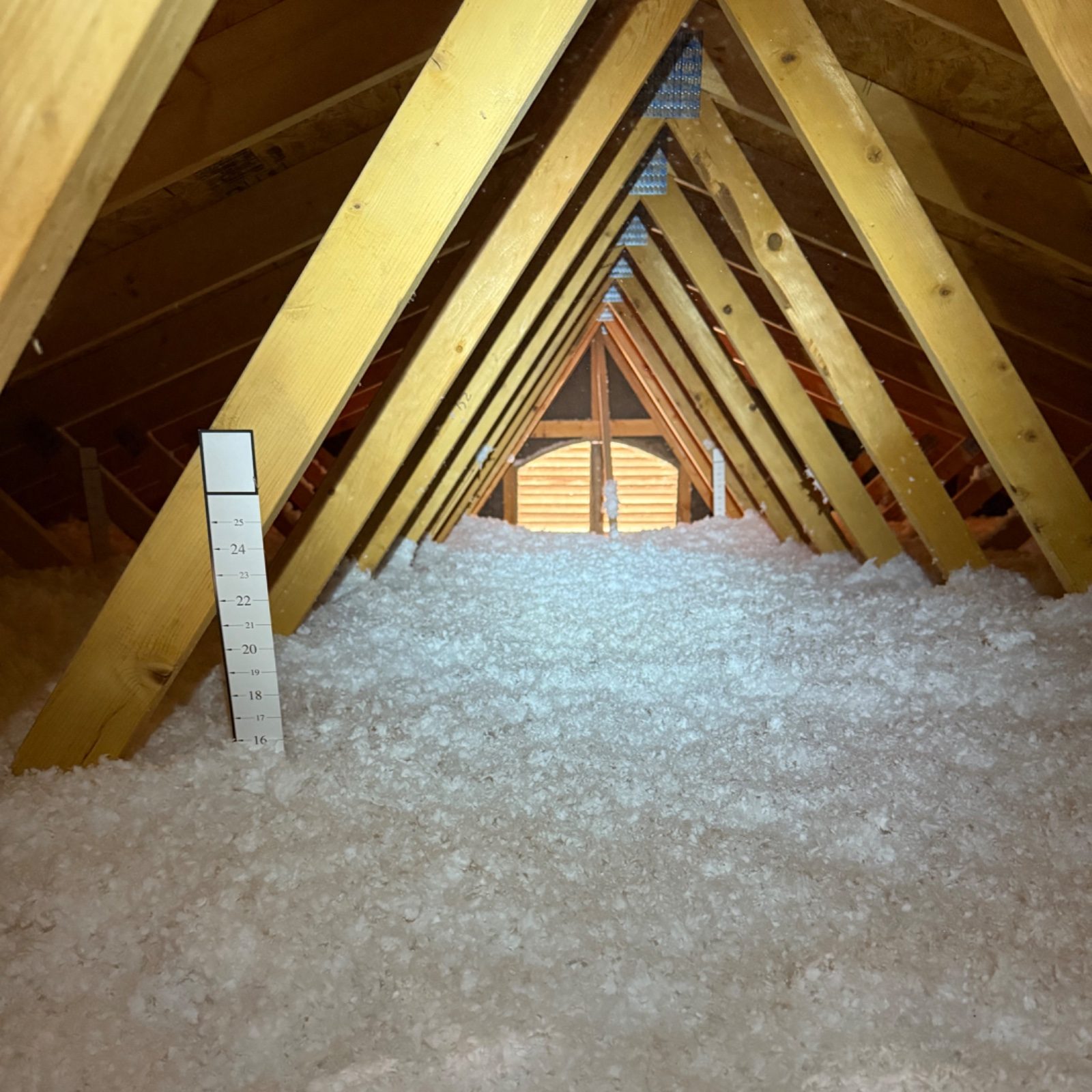
If your home is older than 2000, it’s highly likely this is how your attic looks.

What did builders actually install when your home was built?

Homes built before 1980 typically received R-11 or less at the time of construction, and many of those attics still have that original insulation sitting there today. Builders in that era weren't required to meet any meaningful energy code, and insulation was often treated as an afterthought.

Homes built in the 1980s usually landed somewhere between R-11 and R-19. The energy crisis of the late 1970s pushed some code changes, but enforcement was inconsistent and the standards were still well below what we'd recommend today. You might find 4 to 6 inches of batts or loose fill up there, sometimes both layered together.

Homes from the 1990s through the mid-2000s commonly have R-19 to R-30. That's better, but still short of the R-38 minimum we'd target for this climate. A lot of the Tucson-area subdivisions built during that boom period fall into this category.

Homes built after roughly 2010 are more likely to have R-30 to R-38 already in place, because Arizona adopted stricter energy codes during that period. Even so, we still find newer homes that were under-insulated at build, and insulation that was installed unevenly or left thin in corners and eaves. You can see more about what we find in common attic problems across all home ages.

How do you measure what's already up there?

The simplest method is a ruler or tape measure. First, find your attic access hatch and get a flashlight. Second, look for depth markers if they exist (some older installs have them stapled to joists). Third, push a ruler straight down through the insulation until it hits the attic floor, then read the depth. One inch of blown-in fiberglass is roughly R-2.5 to R-3, so 6 inches gets you to about R-15 to R-18, and 13 inches gets you to around R-38.

The tricky part is that insulation depth varies across an attic. It tends to be thinner near the eaves, near the hatch, and anywhere someone has walked through. A single measurement in the center of the attic can give you a falsely optimistic picture. We always check multiple spots when we do a free attic inspection, because the low spots are where the heat gets in.

If you're not comfortable going up there yourself, that's completely fine. We do free attic inspections and we'll give you an honest read on what's there, where it's thin, and what it would take to bring things up to R-38 or R-49. No pressure, just information.

What R-value should you target if you're adding insulation now?

We recommend targeting R-49 for most Tucson-area homes, especially those built before 2000. R-38 is the floor, not the goal. The extra depth from R-38 to R-49 is not a large cost difference once a crew is already set up and blowing material, but it meaningfully extends the time before the insulation needs attention again.

The material we use is CertainTeed InsulSafe blown-in fiberglass. It does not settle over time, which matters because one common concern homeowners have is that blown-in insulation will compress and lose R-value after a few years. InsulSafe is engineered to hold its loft. What you install today is what you'll have a decade from now.

For homes that are already at R-19 or R-22, we're adding material on top of what's there rather than starting from scratch. The existing insulation still counts toward your total R-value, so the amount we add depends entirely on your starting point. That's why pricing for blown-in insulation in Tucson runs $1.25 to $2.00 per square foot, with where you land in that range depending on how much insulation is already up there.

How long does the install actually take?

Most installs take 2 to 3 hours from the time we arrive to the time we're packed up and gone. The actual blowing goes quickly once the equipment is set up. What takes time is the setup, making sure every area of the attic floor gets covered evenly, and a final check to confirm depth is consistent across the space.

We're in and out without disrupting your day much. You don't need to leave the house, and there's no mess left behind in the living area. The attic access gets cleaned up before we leave. For most homeowners in the Tucson metro, same-day appointments are often available. If you're in Sierra Vista, Cochise County, or the Phoenix East Valley, we work those areas on scheduled service days.

Does home age change whether you should add a solar attic fan too?

Older homes, particularly those built before 1990, often have ventilation systems that were undersized from the start or have degraded over time. Poor ventilation means heat builds up in the attic even faster, which shortens the effective life of your insulation and makes your AC work harder. Adding insulation to a poorly ventilated attic helps, but pairing it with a solar attic fan addresses both sides of the problem.

We install a 30W solar attic fan. It runs entirely off the sun, so there's no wiring cost and no impact on your electric bill. On a hot afternoon, a properly sized fan can drop attic temperatures significantly, reducing the heat load on your insulation and your living space below. You can read more about how we approach attic ventilation and why it matters alongside insulation.

For homeowners who want to do both at once, we offer an insulation and solar fan combo that bundles the work into a single visit. That's often the most efficient way to handle an attic that's been neglected for a while.

What should you do next if you're not sure where your home stands?

The honest answer is: get someone up there to look. A lot of homeowners have no idea what's in their attic until they ask. We offer free attic inspections with no obligation, and we'll tell you exactly what we find, including the depth at several points, the condition of the material, and what R-value you're working with now versus what we'd recommend.

If you want to get a rough sense of cost before calling, our savings calculator can give you a starting point based on your home's square footage. And if you want to see what other Tucson homeowners have said about working with us, we're rated 4.9 stars from 41 Google reviews.

We're licensed under Arizona ROC #365778 and we work Monday through Saturday, 7 AM to 6 PM. You can book a free inspection online, or call us at (520) 261-3001. We're a local crew and we'll give you a straight answer, not a sales pitch. For more detail on what the inspection and install process looks like, this post on what to expect from insulation contractors in Tucson walks through it step by step.

Common Questions

How many inches of blown-in insulation do I need to reach R-38 in Arizona?

You need roughly 12 to 13 inches of blown-in fiberglass to reach R-38, since blown-in fiberglass provides approximately R-2.9 to R-3.0 per inch. If you already have 6 inches of existing insulation, you'd be adding around 6 to 7 more inches on top to hit that target.

Can I just add insulation on top of what's already there?

Yes, in most cases you can add new blown-in insulation directly on top of existing material, and the existing insulation still counts toward your total R-value. The new material goes right over the old. We do not do removal or tear-out work, so if existing insulation is in reasonable condition, topping it off is the standard approach.

How much does it cost to insulate a Tucson attic?

Our pricing runs $1.25 to $2.00 per square foot. Where a job lands in that range depends on how much insulation is already in the attic. A free inspection is the fastest way to get an accurate number for your specific home.

Does blown-in insulation lose R-value over time?

The CertainTeed InsulSafe blown-in fiberglass we use does not settle over time, so it holds its R-value. The main reason insulation loses effectiveness in Arizona attics is physical disturbance, like someone walking through the attic, or gaps that were never filled properly at installation.

Do newer Arizona homes already have enough insulation?

Not always. Homes built after 2010 are more likely to meet current code minimums, but we still find newer homes with uneven coverage or thin spots near eaves and corners. The only way to know for sure is to measure depth at multiple points across the attic floor, which we do during a free inspection.

About Arizona Attic Pros

Arizona Attic Pros is a family-owned, fully insured attic insulation and 30W solar attic fan installation company (Arizona ROC #365778) owned by brothers Mike and Scott. We install CertainTeed InsulSafe blown-in fiberglass to R-38 to R-49 and provide free attic inspections throughout the Tucson metro, Sierra Vista and Cochise County, and the Phoenix East Valley.

Related Articles

February 2026
7 Signs Your Tucson Home Needs New Attic Insulation
Read →
April 2026
What's the Best R-Value for Arizona Attics? A Tucson Guide
Read →
March 2026
How Long Does Attic Insulation Last in Arizona?
Read →