For most Tucson and East Valley homes, blown-in insulation delivers more reliable, year-round comfort improvement than a radiant barrier alone. A radiant barrier reflects radiant heat coming off the roof deck, which is real and significant when attic temps push past 150°F in summer. But a radiant barrier does nothing to slow the conductive heat that has already built up in the attic air and is pressing against your ceiling. Blown-in insulation slows that conductive transfer all day and all night, in every season. The two products solve different parts of the same problem, and understanding that distinction is the fastest way to decide what your home actually needs.
★★★★★
4.9-Star Rated
55 Google Reviews
October 2026·5 min read
Radiant Barrier vs Blown-In Insulation in Arizona: Which One Does Your Attic Actually Need?
Both radiant barriers and blown-in insulation reduce heat in Arizona attics, but they work in completely different ways. Here's how to think through which one your home needs, and why most Tucson houses benefit most from the insulation side of the equation.
Radiant barrier: A radiant barrier is a reflective foil material installed in an attic, typically on the underside of roof rafters, that reflects radiant heat energy back toward the roof before it can warm the attic air. It reduces peak summer attic temperatures by addressing radiation specifically, but does not slow conductive heat transfer and provides no insulating R-value. It is distinct from thermal insulation, which resists heat movement by conduction and works in both heating and cooling seasons.
What's the short answer: radiant barrier or blown-in insulation for Arizona?
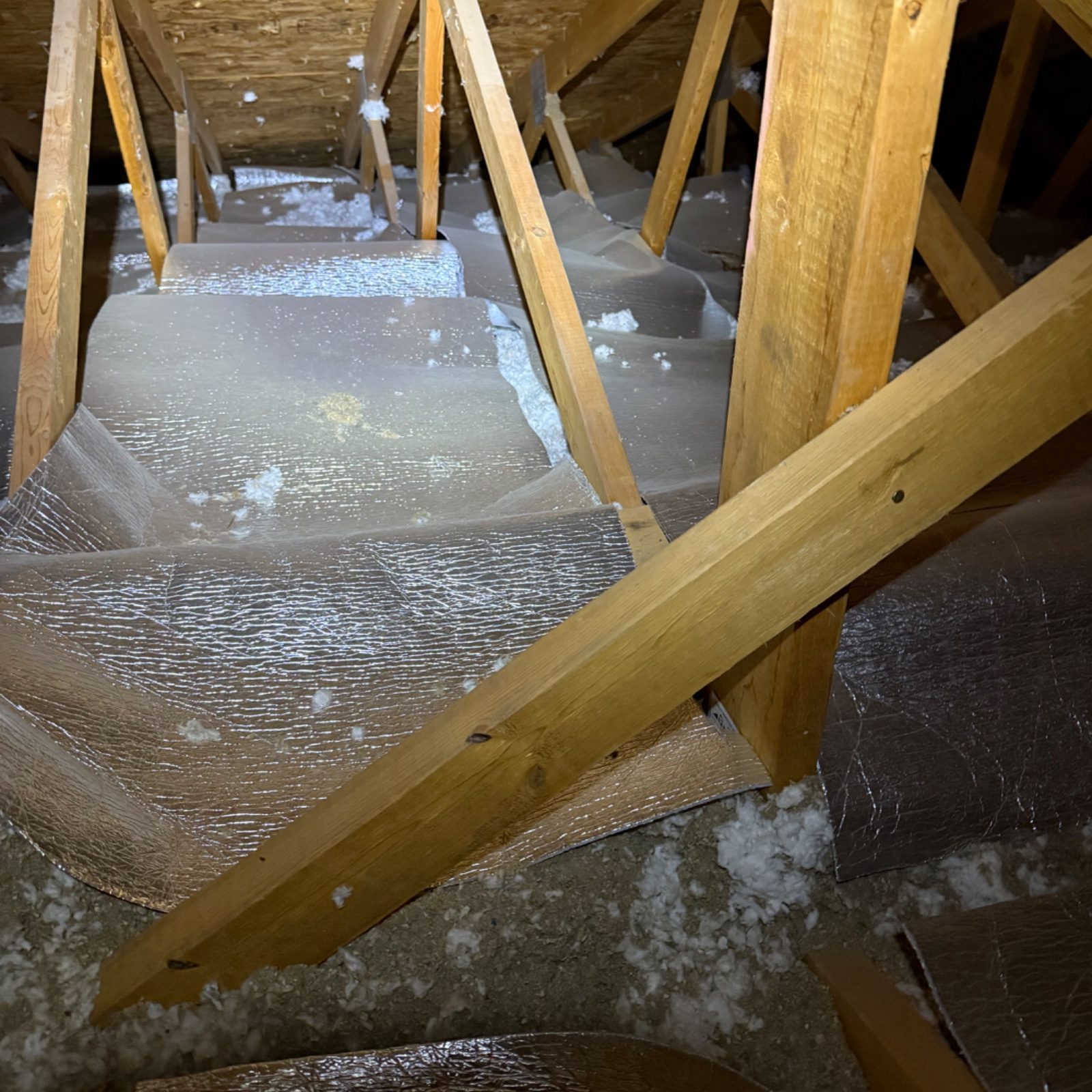
How does a radiant barrier work, and what does it actually do?
A radiant barrier is a reflective foil material, usually stapled to the underside of the roof rafters, that bounces radiant energy back toward the roof before it can warm the attic air. It works on the same principle as the shiny lining inside a car sunshade. In a climate like Tucson's, where summer attic temperatures regularly exceed 150°F, the roof deck itself becomes a powerful radiant heat source, and a barrier can meaningfully reduce peak attic air temperatures.
The important limitation is that a radiant barrier only addresses radiation. Once heat has already entered the attic air through any path, including conduction through the roof deck, gaps, or air leaks, the barrier has no effect on it. It also does nothing during winter nights, when your heated indoor air is trying to escape upward through the ceiling. A radiant barrier is a summer-peak tool, not a whole-system solution.
How does blown-in insulation work differently?
Blown-in insulation slows the movement of heat by conduction through a thick layer of material between the hot attic and your living space. We install CertainTeed InsulSafe blown-in fiberglass, which is blown across the attic floor in a deep, even layer that fills around joists, wiring, and other obstructions. The Department of Energy recommends R-38 to R-60 for attics in hot climates like southern Arizona, and we typically target R-38 to R-49 depending on the home.
The practical difference from a radiant barrier is that insulation works in both directions and at all hours. During the day it slows heat from coming down into your living space. At night, when a 150°F attic finally starts to cool, a well-insulated ceiling keeps that stored heat from radiating back into your bedrooms. And in winter, it keeps conditioned air from escaping upward. CertainTeed InsulSafe also does not settle over time, so the R-value it starts with is the R-value it holds for the life of the home. You can read more about what the blown-in insulation process actually looks like on our service page.
Why do most Tucson homes need more insulation before anything else?
The majority of homes we inspect in Tucson, Marana, Oro Valley, Vail, and Sahuarita are sitting at R-11 to R-19, which was code-minimum decades ago and is nowhere near adequate for DOE Climate Zone 2. At those levels, even a perfectly installed radiant barrier is fighting a losing battle, because the thin insulation layer underneath it offers almost no resistance to the heat that does make it through. Addressing the insulation deficit first gives you a strong thermal floor that works every hour of every day.
A radiant barrier makes more sense as an add-on for homes that already have adequate insulation depth and are still seeing high peak temperatures, or for homes with west- or south-facing roof planes that take a particularly brutal afternoon sun load. Our free attic inspection gives us the chance to measure your current depth and tell you exactly where you stand before recommending anything.
Can you use both a radiant barrier and blown-in insulation together?
Yes, and in some Arizona homes the combination makes sense. The radiant barrier handles peak radiant load from the roof deck, reducing the temperature of the attic air that your insulation then has to resist. The insulation handles conduction and provides the all-hours, all-seasons thermal resistance that a barrier can't. Together, they address the problem from two angles.
That said, the combination isn't always the right call for every budget or every home. If your insulation is at R-11 and your attic is 155°F in July, the single highest-impact move is getting the insulation to R-38 or R-49. Adding a radiant barrier on top of that is a secondary upgrade worth considering, but it won't move the needle as much as closing a 30-point R-value gap. We'll tell you honestly which step makes more sense for your specific attic when we come out. Our insulation and solar fan combo is one popular pairing that addresses both insulation depth and active ventilation at the same time.
What does blown-in insulation cost in Tucson, and how long does it take?
Our pricing for blown-in insulation runs $1.25 to $2.00 per square foot, and where a job lands in that range depends on how much insulation is already in the attic. A home with very little existing material needs more product to reach R-38 or R-49, which moves the price toward the higher end. A home that's already at R-19 and just needs a top-up lands closer to the lower end. You can get a clearer picture for your home using our savings calculator.
Most installs take 2 to 3 hours from setup to cleanup. We work Monday through Saturday, 7 AM to 6 PM, and same-day service is often available for homes in the Tucson metro. Sierra Vista, Cochise County, and the Phoenix East Valley are served on scheduled service days. Our license number is Arizona ROC #365778 if you want to verify us with the state before booking.
What should you actually do next?
If you're not sure whether your attic needs insulation, a radiant barrier, or both, the most useful thing you can do is get an honest look at what's up there. We offer a free attic inspection, and we'll measure your current insulation depth, check for any ventilation issues, and give you a straight answer about what would actually help versus what would just be spending money. No pressure, no upsell for things you don't need.
Our blog post on how hot a Tucson attic gets by month gives good context for understanding the seasonal heat load your attic is dealing with, which helps frame any conversation about solutions. To schedule your free inspection, book online or give us a call at (520) 261-3001. We're here Monday through Saturday, 7 AM to 6 PM.
Common Questions
Does a radiant barrier replace insulation in an Arizona attic?
No, a radiant barrier does not replace insulation. It reflects radiant heat from the roof deck but does nothing to slow conductive heat transfer, which is the main path heat takes into your living space once it's already in the attic air. The Department of Energy recommends R-38 to R-60 for hot-climate attics, and a radiant barrier contributes zero R-value toward that target. Most Arizona homes need both adequate insulation depth and, optionally, a radiant barrier as a secondary upgrade.
Will a radiant barrier help in winter, or is it only a summer product?
A radiant barrier is primarily a summer tool. It works by reflecting radiant energy from a hot roof deck, and that heat source is much weaker in winter. Blown-in insulation, by contrast, slows heat movement in both directions year-round, keeping warm air inside during cool nights and blocking heat from entering during summer days. If you're weighing one investment against the other for whole-year comfort, insulation has the broader benefit.
How do I know if my Tucson attic already has enough insulation?
The quickest field check is to look at the attic floor joists. If you can see the tops of the joists, you're almost certainly under R-19, which falls well short of the R-38 to R-49 target for southern Arizona. A proper measurement with a ruler gives you the actual depth, and from there you can calculate the R-value based on the material type. We measure this during our free attic inspection and tell you exactly where you stand.
How long does it take to install blown-in insulation?
Most installs we do take 2 to 3 hours from setup to cleanup. The job involves blowing CertainTeed InsulSafe fiberglass across the attic floor until it reaches the target depth for R-38 or R-49, depending on what the home needs. The material settles in place immediately and holds its R-value without compressing or degrading over time.
Do you serve areas outside of Tucson?
Yes. We serve the full Tucson metro, including Marana, Oro Valley, Vail, and Sahuarita, with same-day service often available. We also serve Sierra Vista and Cochise County, and the Phoenix East Valley on scheduled service days. You can see the full list of areas on our [service areas page](https://arizonaatticpros.com/service-areas).
About Arizona Attic Pros
Arizona Attic Pros is a family-owned, fully insured attic insulation and 30W solar attic fan installation company (Arizona ROC #365778) run by Mike, the owner. We install CertainTeed InsulSafe blown-in fiberglass to R-38 to R-49 and provide free attic inspections throughout the Tucson metro, Sierra Vista and Cochise County, and the Phoenix East Valley.