★★★★★
4.9-Star Rated
55 Google Reviews
← All Articles
October 2026·6 min read

Builder-Grade Insulation in New Arizona Homes: Why It's Not Enough

Most new Arizona homes leave the builder with R-19 to R-22 in the attic. The DOE recommends R-38 to R-60 for hot climates like southern Arizona. Here's what that gap actually costs you, and how to close it.

Builder-grade insulation: Builder-grade insulation refers to the minimum level of attic insulation installed in new construction homes to meet local building code requirements. In Arizona, this typically means R-19 to R-22, which satisfies code but falls well below the R-38 to R-60 range recommended by the U.S. Department of Energy for attics in hot climates like southern Arizona. The term reflects a code-compliance standard rather than a performance standard.

What R-value does builder-grade insulation in Arizona new construction actually deliver?

Most production builders in Arizona install R-19 to R-22 in the attic, which meets the minimum building code threshold but lands well below what southern Arizona's climate actually demands. The U.S. Department of Energy recommends R-38 to R-60 for attics in hot climates like ours, and we target R-38 to R-49 as the practical sweet spot for DOE Climate Zone 2.

That gap between R-22 and R-38 isn't a minor shortfall. Insulation's job is to slow the rate at which heat moves from your attic into your living space. The lower the R-value, the faster that heat transfer happens, and in a Tucson summer where attic temperatures regularly exceed 150°F, faster heat transfer means your air conditioner is fighting a losing battle from the start.

Builders use minimum-code insulation for straightforward reasons: it keeps construction costs down and passes inspection. That's not a criticism, it's just the economics of production homebuilding. But passing inspection and performing well in a southern Arizona summer are two very different standards.
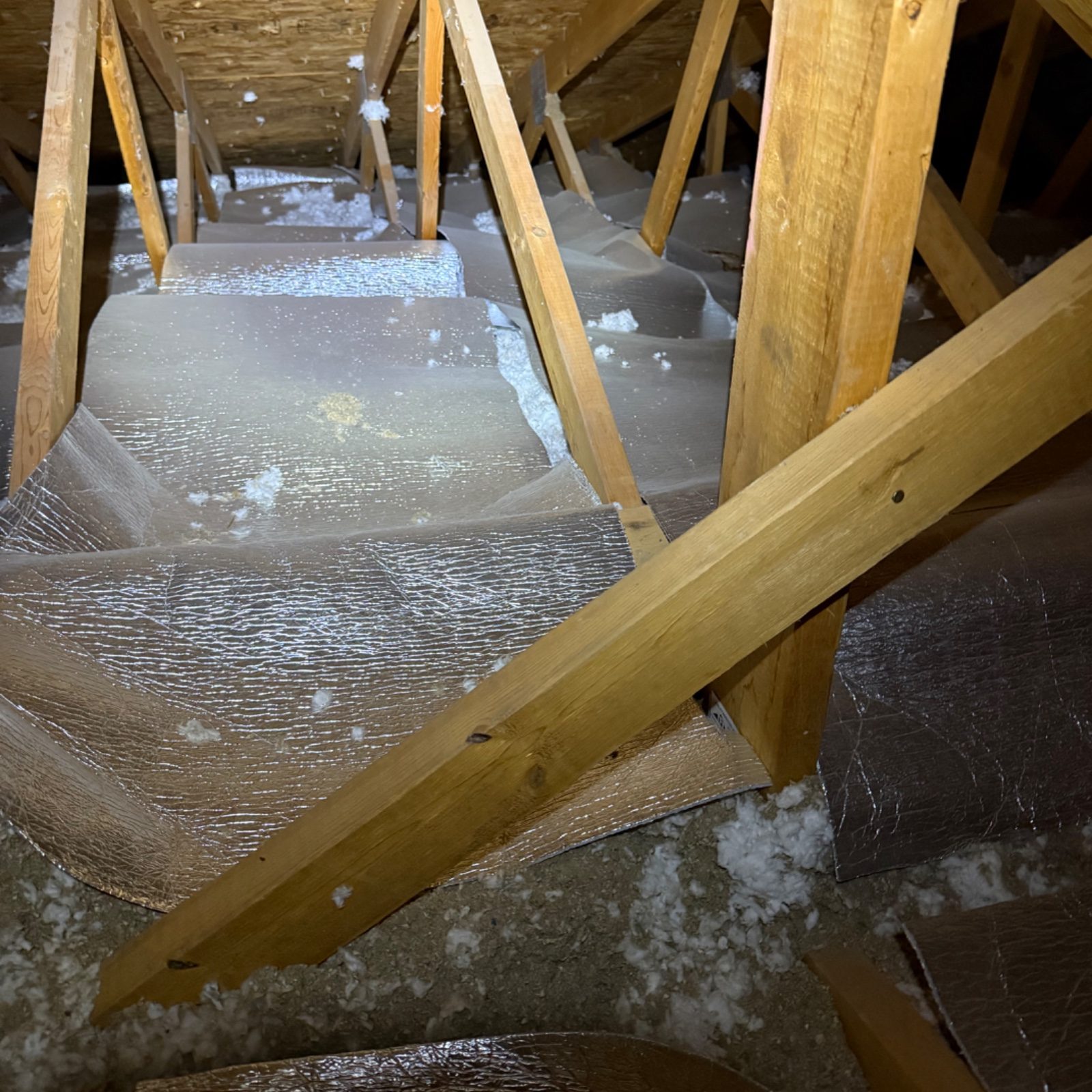
Customer called us out because a competitor of ours installed the insulation like this, only 4 inches of insulation and

Why does builder-grade insulation fall short specifically in Tucson and the East Valley?

Attic temperatures in Tucson regularly exceed 150°F in summer, and that heat load is sustained for months, not just a few hot days. Climate Zone 2, which covers southern Arizona including Tucson, Marana, Oro Valley, Vail, Sahuarita, and the Phoenix East Valley, is one of the most demanding thermal environments in the country for attic insulation.

An attic sitting at 150°F with only R-22 between it and your ceiling is pushing a substantial amount of heat into your home hour after hour. Raise that barrier to R-38 or R-49 and you're cutting that heat transfer rate nearly in half or better. Your air conditioner runs shorter cycles, the rooms directly under the roof stay closer to your thermostat setting, and the system doesn't have to work as hard on the hottest afternoons.

We see this pattern regularly in newer neighborhoods across the Tucson metro. Homeowners move into a brand-new house expecting modern efficiency and are surprised when their electric bills look no better than an older home they left behind. The house itself may be tight and well-built, but the attic is doing very little to help. You can read more about how attic insulation affects your TEP or APS electric bill if you want to see how the math works.

How can you tell if your new home's attic insulation is undersized?

The most direct method is to measure the depth of insulation in your attic. Fiberglass blown-in at R-38 sits roughly 10 to 12 inches deep; R-49 is closer to 14 to 16 inches. If you can see the tops of your ceiling joists clearly, or if the insulation barely covers them, you're almost certainly below R-30.

Beyond the tape measure, there are practical signs. First, check whether rooms on the top floor or directly under the roofline feel noticeably warmer than the rest of the house, even with the AC running. Second, look at your summer electric bills compared to neighbors in similar-sized homes. Third, put your hand on the ceiling in a top-floor room on a hot afternoon. If it feels warm to the touch, heat is moving through.

A free attic inspection is the most reliable way to get a real number. We go up, measure actual depth and coverage, and tell you exactly where you stand. There's no obligation attached to that visit, and you leave knowing your actual R-value rather than guessing.

What insulation material do we install to bring new construction up to standard?

We install CertainTeed InsulSafe blown-in fiberglass, and we use it exclusively. CertainTeed InsulSafe is a non-settling product, which matters because one of the common complaints about older blown-in insulation is that it compresses over time and loses effective R-value. InsulSafe holds its R-value for the life of the home.

Blown-in fiberglass is well-suited to topping off builder-grade insulation because it fills in around obstructions, covers the entire attic floor evenly, and can be added over whatever the builder left behind without any conflict. We're adding material on top of existing insulation to bring the total depth up to the R-38 to R-49 range. The process is straightforward and doesn't require anything to be moved or removed.

If you want the full picture of what blown-in insulation involves, we've covered the details on our service page. The short version: our crew brings the blower truck, runs hoses into the attic, and works methodically across the space to hit consistent depth throughout.

How much does upgrading builder-grade insulation cost in Arizona?

Our pricing runs $1.25 to $2.00 per square foot, and where a specific job lands in that range depends primarily on how much insulation is already present. A new home with R-19 already in place needs less added material to reach R-38 than a home starting from near zero, so the existing depth affects the final number.

For a 1,500-square-foot attic footprint, that range works out to roughly $1,875 to $3,000. Most installs take 2 to 3 hours from start to finish, so this isn't a multi-day project. You can get a more specific estimate for your home's square footage using our savings calculator, or just call us and we'll work through it with you directly.

For a fuller breakdown of how attic insulation is priced in this area, our attic insulation cost page walks through what drives the number up or down.

Does ventilation matter if you're upgrading insulation in a new home?

Good attic ventilation and adequate insulation work together, and a new home with builder-grade insulation sometimes has ventilation that was also sized to minimum code. Insulation slows heat from entering your living space, but ventilation is what moves hot air out of the attic itself, keeping that 150°F number from climbing even higher.

If your attic is under-ventilated, adding insulation still helps significantly, but you're leaving some performance on the table. A 30W solar attic fan is one option we install as part of an insulation and solar fan combo. The solar fan runs on sunlight, so it's working hardest on exactly the days your attic needs it most, without adding to your electric bill.

During a free inspection we check ventilation alongside insulation depth, so you get a complete picture of what's happening up there rather than a partial diagnosis.

What should you do if you just bought a new construction home in Tucson or the East Valley?

The practical first step is to get your attic inspected before the first full summer hits. New homeowners are often in the middle of a dozen other things and attic insulation doesn't feel urgent in October or November. But scheduling in fall means the work is done before June, and you're not discovering the problem when your electric bill arrives.

We serve the Tucson metro, including Marana, Oro Valley, Vail, and Sahuarita, with same-day availability often possible. We also serve Sierra Vista and Cochise County, and the Phoenix East Valley on scheduled service days. Arizona Attic Pros is licensed under Arizona ROC #365778, and you can reach us Monday through Saturday, 7 AM to 6 PM at (520) 261-3001.

The free attic inspection is a real no-obligation visit. We measure, we show you what we found, and we give you a straight answer about whether your insulation is adequate. If it is, we'll tell you that too. Book your free attic inspection online, or call us directly if you'd rather talk through it first.

Common Questions

Is builder-grade insulation in a new Arizona home covered under any warranty or builder obligation?

Builder-grade insulation meets code at the time of construction, and most builders consider that obligation fulfilled once the home passes inspection. There is typically no builder obligation to upgrade insulation beyond code minimums after closing. If you want higher performance, upgrading after purchase is the homeowner's responsibility.

Can blown-in insulation be added on top of what the builder installed?

Yes. CertainTeed InsulSafe blown-in fiberglass can be installed directly over existing builder-grade insulation to bring the total depth up to R-38 or R-49. There's no need to remove what's already there. The new material fills in around existing coverage and raises the overall R-value of the attic floor.

How long does it take to upgrade attic insulation in a new construction home?

Most installs take 2 to 3 hours from start to finish. The exact time depends on the attic's square footage and how much material needs to be added, but for a typical single-family home it's a same-day project that's complete well before the afternoon.

Does a new home need a solar attic fan if the insulation is upgraded?

Not necessarily, but the two work well together. Insulation slows heat from entering your living space; a solar attic fan helps exhaust hot air from the attic itself. In a Tucson summer where attic temperatures regularly exceed 150°F, combining both gives you better overall performance than either one alone. During a free inspection we'll tell you honestly whether ventilation is a factor in your specific attic.

What R-value should a new Arizona home's attic actually have?

The U.S. Department of Energy recommends R-38 to R-60 for attics in hot climates like southern Arizona. We target R-38 to R-49 as the practical range for DOE Climate Zone 2, which covers Tucson, the East Valley, and surrounding communities. Most new construction homes arrive at R-19 to R-22, so there's a meaningful gap to close.

About Arizona Attic Pros

Arizona Attic Pros is a family-owned, fully insured attic insulation and 30W solar attic fan installation company (Arizona ROC #365778) run by Mike, the owner. We install CertainTeed InsulSafe blown-in fiberglass to R-38 to R-49 and provide free attic inspections throughout the Tucson metro, Sierra Vista and Cochise County, and the Phoenix East Valley.

Related Articles

September 2026
How Hot Does a Tucson Attic Get by Month? A Real-Numbers Guide
Read →
September 2026
R-38 vs R-49 vs R-60 Insulation: Which R-Value Does a Tucson Home Actually Need?
Read →
September 2026
How Much Attic Insulation Do You Need in Arizona, by Home Age?
Read →